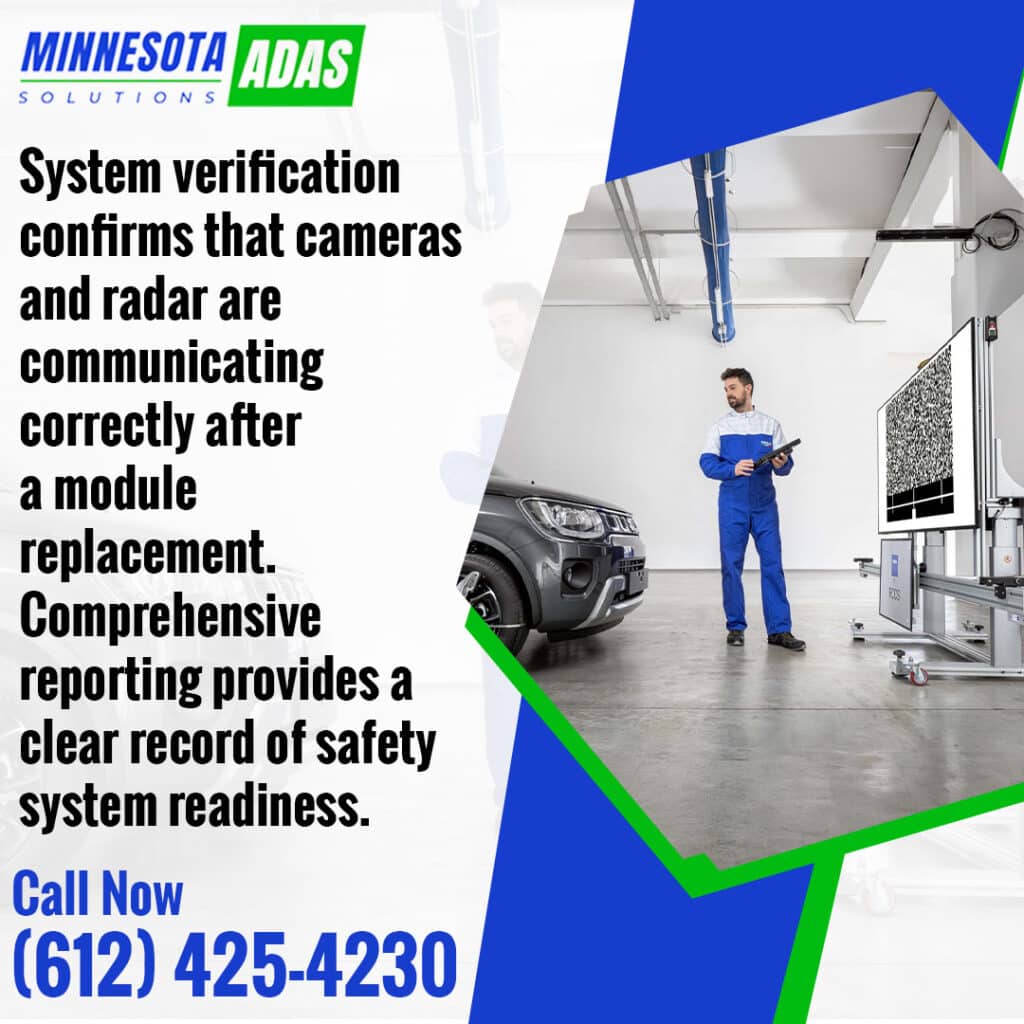
When you complete collision repairs or calibration work, you deal with more than just mechanical fixes. You are responsible for how a vehicle’s safety systems respond on the road. ADAS system verification and documentation record post-repair system status of cameras, radar, and sensors, typically through scan tools and functional checks, to help confirm whether required calibration and diagnostic procedures were completed. This step supports both repair accuracy and liability protection for your shop and your customers.
At MN ADAS Solutions, Bloomington, you work with a team focused on ADAS diagnostics, calibration, and verification services in Minnesota. You gain structured reporting that shows how each system performs after repair. This includes scan results, calibration records, and post-service validation data. If you run a collision shop or manage repairs, this process helps you back your work with clear technical records. If you are a vehicle owner, it shows how your safety systems respond after service.
What ADAS System Verification and Documentation Means
ADAS system verification and documentation give you a structured way to confirm how vehicle safety systems perform after repair or calibration work. You work with systems that directly influence braking, steering input, and hazard detection. This section explains how each part of the process supports repair accuracy and recordkeeping across collision repair workflows.
Purpose of ADAS Verification After Repairs
ADAS system verification confirms that safety systems respond correctly after repair or calibration work. You rely on this step to check how each system reacts after changes to sensors, cameras, or control modules. It focuses on system response, sensor accuracy, and communication between modules.
You typically perform verification after:
- Collision repairs that affect the structure or mounting points
- Sensor replacement or repositioning
- Calibration services completed on ADAS systems
Systems Included in Verification (Camera, Radar, Sensors)
ADAS system verification includes all electronic safety sensing components in a vehicle. You work with multiple systems that function together to support driver assistance features.
These include:
- Forward-facing cameras used for lane tracking and object recognition
- Radar sensors are used for distance measurement and adaptive cruise functions
- Ultrasonic sensors are used for low-speed object detection and parking support
Each system communicates with control modules. If one system reports incorrect data, it affects the full safety network.
Difference Between Calibration and Verification
Calibration adjusts system alignment, while verification confirms system output after adjustment. You use calibration when you need to correct sensor angles or reset system parameters after repair. You use verification to check whether the system responds correctly after those adjustments.
| Process | Function |
| Calibration | Adjust sensor position and system settings |
| Verification | Confirm system response and communication accuracy |
Both steps work together in post-repair ADAS service workflows.
Why Documentation Matters for Safety and Liability
ADAS system verification and documentation provide recorded proof that safety systems were tested after service. You use documentation to support technical accountability across repair and insurance processes. It provides a clear service record that shows system status before and after work.
This supports:
- Insurance claim validation after collision repair
- Collision shop compliance with repair standards
- Long-term vehicle safety history tracking
Documentation also reduces disagreements between repair providers, insurers, and vehicle owners by providing structured test results and scan data.
Role of ADAS System Verification in Collision Repair
ADAS system verification plays a direct role in how you return a repaired vehicle to safe road use. You work with systems that rely on precise electronic inputs, and any mismatch after repair affects how the vehicle responds in real conditions. You rely on verification to confirm that each system responds within expected parameters after repair work. This step connects your repair process with measurable system output.
Post-repair System Checks
Post-repair checks confirm that ADAS systems function correctly after structural or component repairs. You use this stage to review system behavior after physical work on the vehicle.
Technicians review:
- Sensor alignment
- Camera positioning
- Radar signal accuracy
ADAS diagnostics identify system faults before calibration work begins.
This process reviews:
- Sensor output
- Camera calibration status
- Radar communication signals
You use these results to decide what correction steps to follow next. This reduces uncertainty in the repair workflow and supports accurate system restoration.
Sensor Alignment Confirmation
Sensor alignment confirmation supports accurate detection of road conditions. You work with tight tolerances, where even small changes in mounting position affect system readings.
Small shifts in mounting position can affect:
- Lane detection accuracy
- Emergency braking response
- Distance measurement
You rely on alignment checks to bring sensor output back into a measurable range. This step supports consistent system behavior across different driving scenarios.
Preventing Hidden System Faults
Verification helps identify system errors that are not visible during standard inspections. You may not see these faults through visual checks alone.
Without this step:
- Sensors may read incorrect data
- Alerts may not activate
- Driver assistance functions may behave incorrectly
You use verification to expose these issues before the vehicle returns to service. This reduces uncertainty in post-repair performance.
Impact on Insurance Claims and Liability
ADAS system verification and documentation support insurance approval and reduce liability exposure for repair shops. You rely on structured records to support your repair decisions.
It provides:
- Proof of completed work
- System performance records
- Compliance evidence for repair standards
Minnesota ADAS Solutions supports collision shops and repair facilities with structured ADAS verification and documentation processes that align with OEM requirements.
ADAS Calibration vs Verification Process
Calibration and verification sit at the core of ADAS service work after repairs. You deal with two connected steps that serve different roles. One adjusts system behavior, while the other confirms system output after work is completed. You rely on both steps when working on modern safety systems. Each vehicle requires structured handling so sensors, cameras, and radar units communicate correctly across all modules.
Calibration Process Overview
Calibration adjusts ADAS systems to manufacturer specifications. You perform calibration when sensors or cameras no longer align with factory reference points. This step resets system accuracy so components respond based on correct spatial data.
It includes:
- Camera alignment
- Radar adjustment
- Sensor positioning
You also work with system software during this stage.
ADAS programming and coding updates vehicle control modules after repair or part replacement.
This process covers:
- Module configuration
- Software alignment
- System communication restoration
You interact with vehicle control units, so each ADAS component shares accurate data across the network. This step supports communication between sensors and onboard systems after repair work.
Verification Process Steps
Verification confirms system performance after calibration or repair work. You run verification after adjustments to confirm how each system responds during operation.
Steps include:
- System scanning
- Functional testing
- Error code review
You review scan results and system behavior under controlled conditions. This helps you confirm whether calibration work meets the required system responses.
When Both are Required
Both calibration and verification are required after most ADAS-related repairs. You apply both steps when vehicle systems are affected by impact, part replacement, or structural changes.
Common situations include:
- Collision repair
- Windshield replacement
- Suspension or framework
- Sensor replacement
Post-collision ADAS calibration restores sensor and camera alignment after impact damage.
This step addresses:
- Camera positioning
- Radar accuracy
- Sensor alignment
Common Repair Scenarios Requiring Both Services
You often perform calibration and verification together in repair environments where safety systems are exposed to disruption. These services are often required together when:
- Front-end damage occurs
- Lane camera systems are replaced
- Radar units are repaired or replaced
Minnesota ADAS Solutions applies both processes in a controlled environment so each vehicle receives structured system validation and documented results for repair records and compliance tracking.
ADAS System Verification and Documentation Standards
ADAS system verification and documentation are commonly performed in accordance with OEM repair information and industry best practices, which may include pre- and post-repair scanning, calibration procedures, and documented test results, depending on the vehicle manufacturer. You work within these standards to connect repair activity with verified system performance data that can be reviewed by insurers, repair networks, and vehicle owners.
OEM Requirements for Documentation
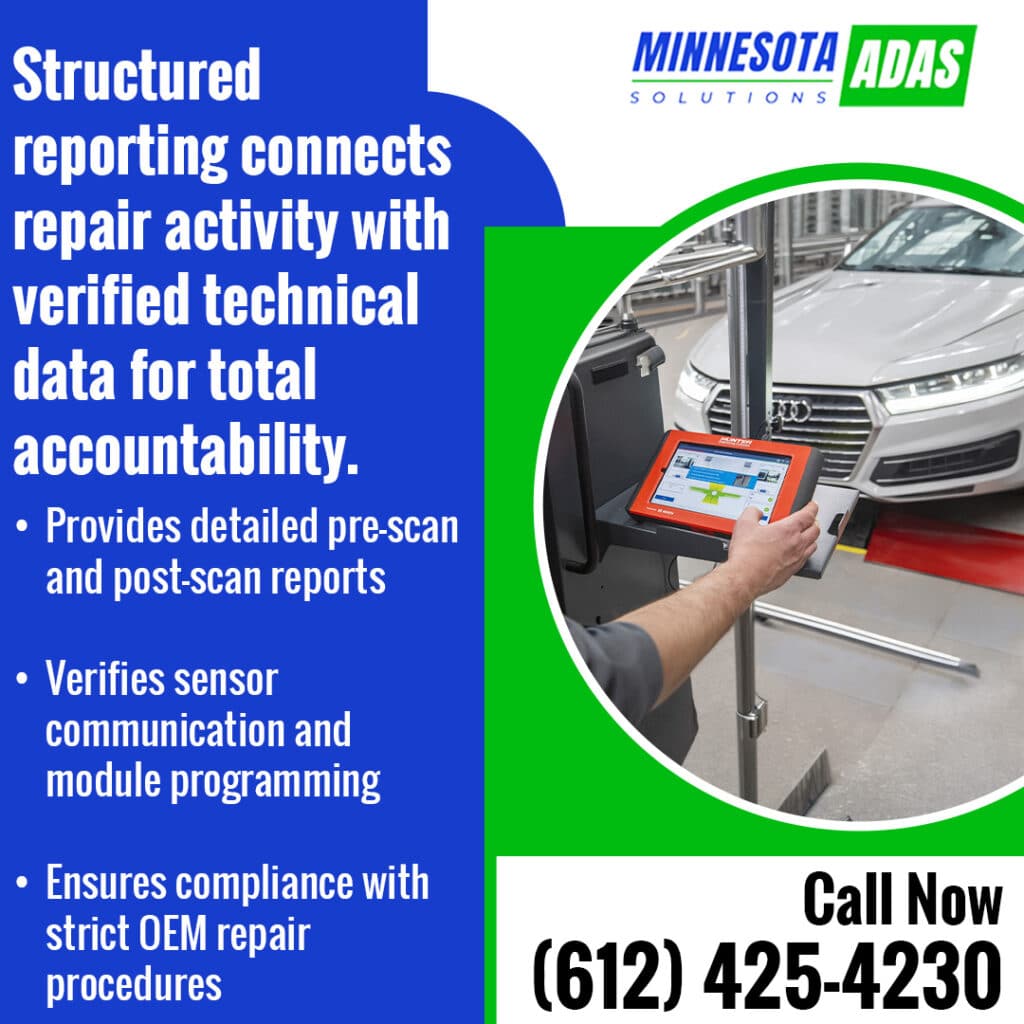
OEM standards require recorded proof of ADAS system performance after service. You work with a documentation process that captures how each safety system responds after calibration or repair. This record typically includes pre-repair scan results that show existing fault codes or system irregularities, followed by post-repair scan results that confirm updated system status. Calibration records also form part of this file and show what adjustments were completed during service.
OEM ADAS calibration procedures define manufacturer-approved steps for restoring system accuracy. These procedures follow structured requirements that guide how sensors, cameras, and radar units are aligned. Factory alignment targets set reference points for calibration work. Scan tool processes guide how technicians interact with system modules. Validation checks confirm system response after calibration work is completed.
Pre-scan and Post-scan Reporting
Pre-scan and post-scan reports show system status before and after repair. You rely on these reports to document the condition of ADAS systems at different stages of service.
| Report Type | Purpose |
| Pre-scan | Identify existing faults |
| Post-scan | Confirm repair outcome |
Pre-scan reports capture stored fault codes and system warnings before work begins. Post-scan reports confirm how those issues were addressed after calibration or repair. This comparison gives a clear record of system changes.
Calibration Records and Proof of Service
Calibration records document how ADAS systems were restored to specification. These records include vehicle system data collected during service, the calibration steps completed by technicians, and the final system status after adjustments. You use these records as technical proof that safety systems were reviewed and brought back into proper working condition.
Importance of Collision Shop Compliance
Proper documentation supports collision shops in meeting insurance and OEM requirements. You depend on accurate records to support audit readiness during inspections or reviews. These documents also validate repair work for insurers and provide transparency for customers who request service history details. Clear documentation reduces disputes and helps maintain consistent reporting standards across repair processes.
Minnesota ADAS Solutions: Verification and Documentation Services
We work directly with collision shops and vehicle owners who need clear records of ADAS system performance after repairs or calibration. Our focus stays on ADAS diagnostics, calibration, verification, and structured documentation in Bloomington, MN.
We treat verification and documentation as part of the repair workflow, not an optional add-on. This approach supports repair accountability and helps you connect technical work with traceable system results.
Company Overview
We provide ADAS diagnostics, calibration, programming, verification, and documentation services built around OEM requirements. At Minnesota ADAS Solutions, we concentrate on vehicle safety systems that rely on cameras, radar, and sensor networks. Our work includes ADAS diagnostics, ADAS programming and coding, post-collision ADAS calibration, ADAS system verification and documentation, and OEM ADAS calibration procedures. We approach each service with a focus on system accuracy and consistent reporting.
We work with you to support collision repair workflows where safety system performance must be confirmed and recorded. Our role is to connect technical adjustments with documented results that reflect the condition of each ADAS system after service.
Service Process at Minnesota ADAS Solutions
We follow a structured service process that moves each vehicle through diagnostics, calibration when required, verification, and reporting. Your vehicle enters our facility for intake and initial review. We begin with ADAS diagnostics in Bloomington, MN, to identify system status and detect fault codes or alignment concerns. If calibration is required, we perform the adjustment using OEM-based procedures.
After calibration, we complete ADAS system verification and documentation. We record system responses, scan results, and calibration outcomes. You receive a full report that reflects each step completed during service. This gives your shop or your records a clear technical reference for the work performed.
Facility Standards and Controlled Environment
All services take place in a controlled calibration environment aligned with OEM requirements. We maintain stable testing conditions that support repeatable measurement and system checks. This allows us to work with consistent lighting, level surfaces, and defined calibration targets. These conditions support accurate sensor alignment and reliable system output across different vehicle makes and models.
Our setup reduces variables that can affect ADAS system readings. This gives you documented results that reflect controlled testing conditions and structured calibration procedures.
Schedule ADAS Diagnostics and Documentation Services in Bloomington, MN
You work with ADAS systems that demand accurate verification after repair, and Minnesota ADAS Solutions supports you with ADAS diagnostics in Bloomington, MN, along with ADAS programming and coding for complete system readiness. Call us at (952) 209-4022 or email info@mnadas.com to schedule service or request documentation support for your next collision repair job.
Our team provides structured ADAS system verification and documentation that helps you support repair records with clear technical output. You can contact us to set up service and keep your collision repair process aligned with OEM-based reporting and system validation standards.