
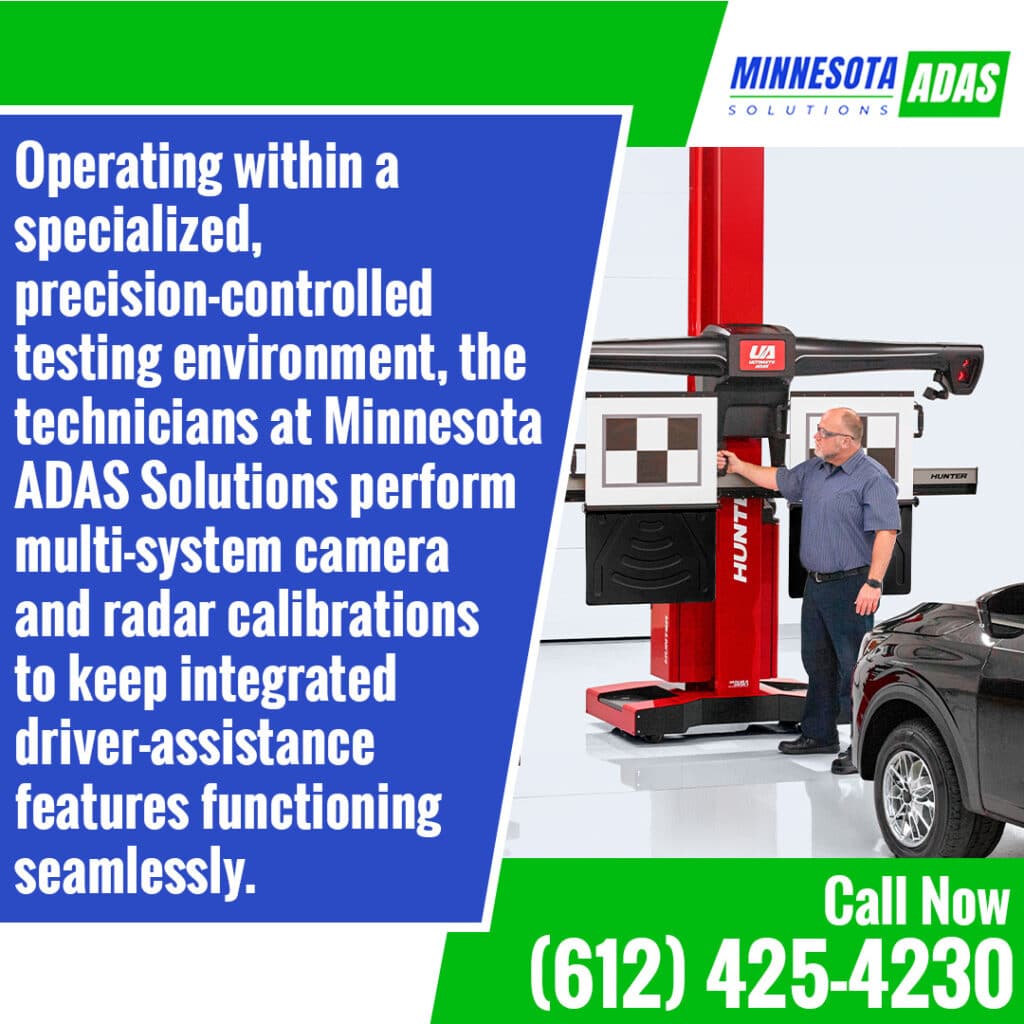
Camera and radar calibration affect multiple ADAS features simultaneously because most safety systems share the same sensors. A single forward-facing camera powers lane departure warning, forward collision warning, and other features at once. When that camera shifts out of alignment, every feature depending on it stops working correctly. At MN ADAS Solutions, Bloomington, we recalibrate every affected sensor to OEM specifications, so all your safety systems perform as engineered.
How Do ADAS Safety Features Share Sensors?
Your vehicle’s safety systems do not each have their own dedicated sensor. They share a network of cameras and radar units mounted at fixed positions on the vehicle.
Radar sensors detect the position, speed, movement, and size of objects, helping ADAS systems identify potential collisions and enable adaptive cruise control. Cameras capture visual information, supporting functions like lane departure warning, traffic sign recognition, and pedestrian detection.
The same radar and camera sensors that power forward collision warning often pull double duty with adaptive cruise control. Working alongside lane departure warning systems, forward collision warning creates a more complete safety net, with the same forward-facing cameras watching for potential collisions while also monitoring lane markings.
This is why camera and radar calibration is not a single-feature fix. When one sensor drifts out of position, every feature tied to it is affected at the same time.
ADAS Features Affected by a Single Miscalibrated Sensor
| Sensor Type | ADAS Features Dependent on It |
| Forward-facing camera | Lane departure warning, forward collision warning, traffic sign recognition, pedestrian detection |
| Front radar | Adaptive cruise control, automatic emergency braking |
| Side/rear radar | Blind spot monitoring, rear cross-traffic alert |
A single misaligned front radar unit, for example, directly disrupts both adaptive cruise control calibration and automatic emergency braking. Both systems read from the same source. If that source is off, both systems fail to respond accurately.
What Happens When Camera and Radar Calibration Is Off?
Each safety feature depends on the sensor reading the road from a precise angle and distance. Research from the Insurance Institute for Highway Safety (IIHS) shows that properly functioning forward collision warning systems reduce rear-end crashes by up to 27%. That reduction depends entirely on accurate sensor alignment.
When calibration shifts, the effects show up across multiple systems:
- Adaptive cruise control calibration: The radar may calculate the wrong distance to the vehicle ahead, causing the system to brake too late or speed up unexpectedly.
- Lane departure warning calibration: A misaligned camera changes how lane markings appear to the system, triggering false alerts or missing actual lane drift.
- Forward collision warning calibration: With an incorrect camera angle, the system may not detect an approaching vehicle at the right time.
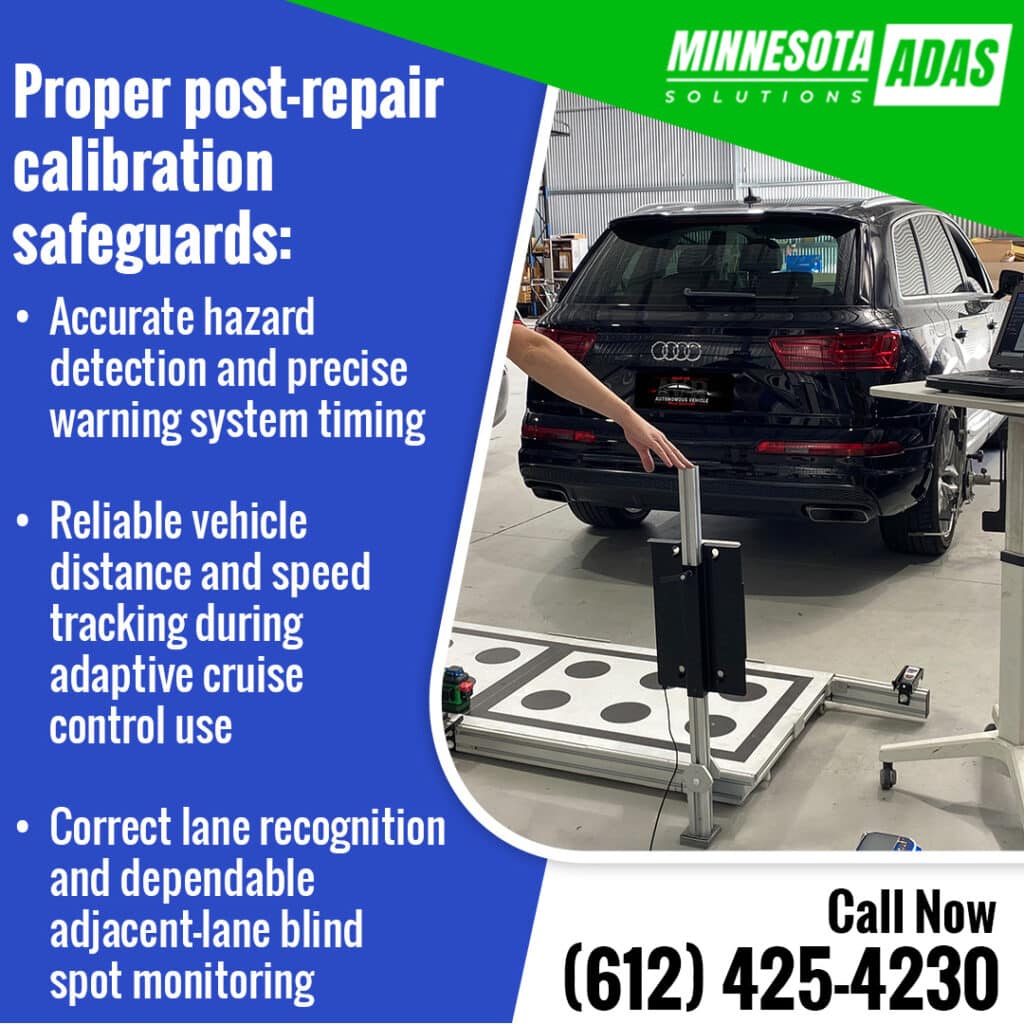
- Blind spot monitoring calibration: Side radar positioned incorrectly can miss vehicles in adjacent lanes or report false detections.
Camera and radar calibration directly affects how safety systems respond during driving. If calibration shifts, your vehicle may react late or provide incorrect alerts.
Frequently Asked Questions
- Does recalibrating one sensor fix all the features tied to it?
Yes. When a shared sensor is recalibrated to manufacturer specifications, all features depending on it are restored at the same time. Camera and radar calibration has a broad effect, both when things go wrong and when they are corrected.
- How do I know if my ADAS features are miscalibrated?
Warning lights are one sign, but not always present. Watch for false lane departure alerts, inconsistent adaptive cruise control, or unreliable blind spot monitoring. If your vehicle had recent repairs, a windshield replacement, or suspension work, get calibration verified.
- Does ADAS calibration need a specialized facility?
Yes. It requires level flooring, precise target placement, and OEM-standard alignment. General shops often lack this setup. Minnesota ADAS Solutions operates certified facilities built specifically for accurate, compliant calibration.
Get Your ADAS Systems Calibrated Correctly
When one sensor is off, your entire safety system pays for it. Our team at Minnesota ADAS Solutions performs camera and radar calibration in a controlled, OEM-standard facility in Bloomington, MN. Every calibration is fully documented, so you have proof that your vehicle’s safety features are working as intended. Schedule your appointment online or call us at (612) 425-4230 or email info@mnadas.com.