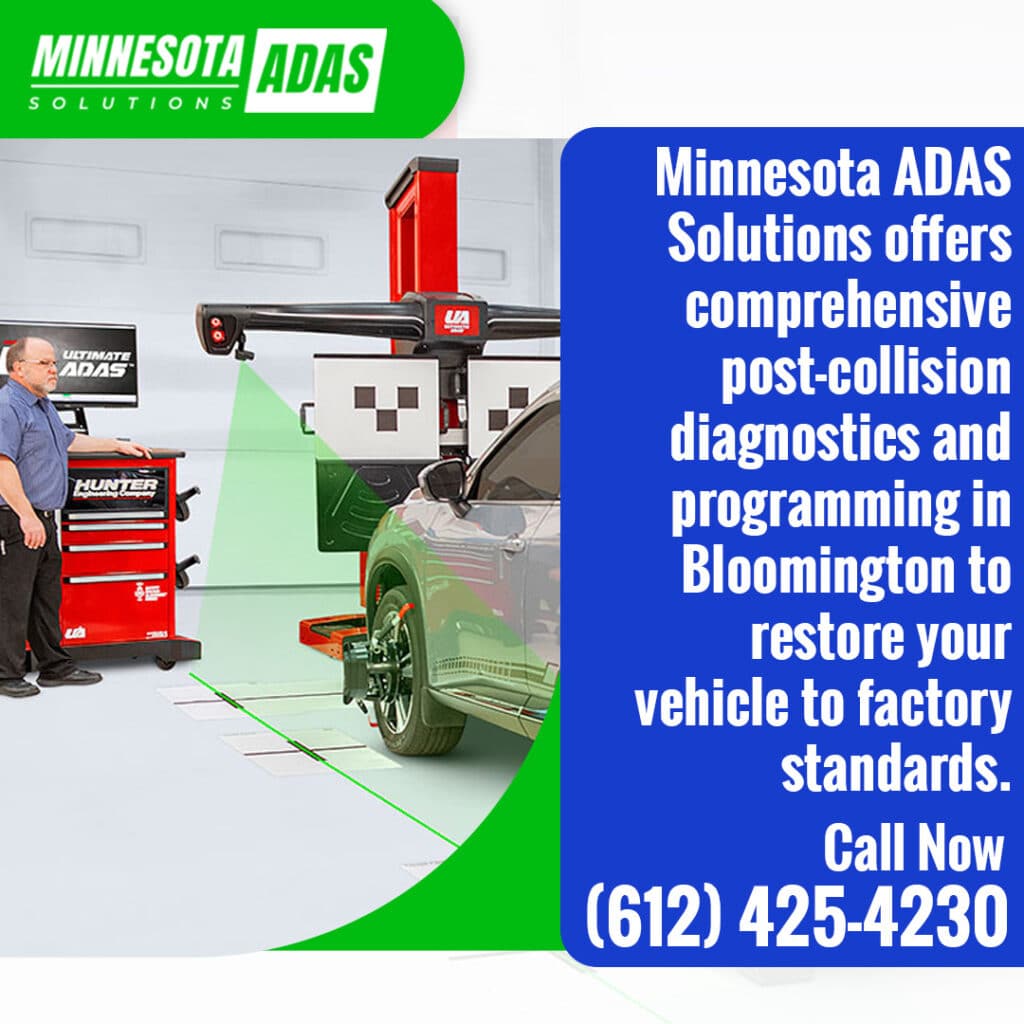
Post-collision ADAS calibration restores vehicle safety systems after accidents or repairs. At MN ADAS Solutions, Bloomington, we provide expert services for drivers, focusing on Advanced Driver-Assistance Systems (ADAS) that rely on cameras, sensors, and radar to detect road conditions.
When a collision occurs, even minor misalignments can affect braking, lane-keeping, and collision warning systems. Our team performs thorough ADAS diagnostics in Bloomington, MN, to identify any system issues, followed by precise ADAS programming and coding to adjust sensors and software. We complete post-collision ADAS calibration to restore system alignment and test every feature through ADAS system verification and documentation. Every step follows OEM ADAS calibration procedures, meeting manufacturer standards for each vehicle. By working with us, you receive professional attention that maintains safety system performance and keeps your vehicle ready for the road.
Understanding ADAS Components and Functions
Advanced Driver-Assistance Systems (ADAS) are complex networks of technologies that work together to make driving safer. Knowing how these components function helps you see why proper calibration matters after a collision.
Key Systems in Modern Vehicles
ADAS includes safety technologies designed to reduce accidents. Modern vehicles rely on several systems that actively support you on the road:
- Adaptive Cruise Control (ACC): This system monitors traffic ahead and automatically adjusts your vehicle’s speed to maintain a safe following distance.
- Lane-Keeping Assist (LKA): LKA detects lane markings and provides steering input to prevent unintended lane departures. Research indicates that lane-departure warning and assist technologies lower single-vehicle roadway departure crashes by up to 11%.
- Automatic Emergency Braking (AEB): AEB applies braking when the system detects a potential collision. The National Highway Traffic Safety Administration (NHTSA) reports that vehicles with AEB can reduce front-to-rear crashes by almost 50%.
- Forward Collision Warning (FCW): FCW alerts you to obstacles or vehicles ahead, giving you time to react. FCW can reduce the severity and frequency of collisions when paired with AEB systems.
These systems depend on precise sensor data. Even small deviations in alignment or calibration can cause delayed responses, missed alerts, or false warnings, affecting your driving experience and safety.
Sensors, Cameras, and Radar Units
ADAS relies on sensors, cameras, and radar to interpret the environment. Each component has a distinct function that supports vehicle safety:
- Cameras: Positioned around the vehicle, they detect lane markings, traffic signs, and obstacles in your path.
- Radar Units: These units measure distance and relative speed of nearby vehicles, aiding adaptive cruise control and collision avoidance.
- Ultrasonic Sensors: Used primarily for parking and low-speed maneuvers, they detect nearby objects that may not appear in mirrors or cameras.
Even slight misalignment of these components can reduce system performance, causing false alerts or delayed reactions. Calibration performed by trained technicians corrects these errors, bringing the sensors, cameras, and radar back to manufacturer specifications.
Post-Collision Calibration Process
Every collision can impact your vehicle’s Advanced Driver-Assistance Systems (ADAS). Calibrating these systems after repair work restores their ability to respond to road conditions and driver input. Here’s how the process works step by step.
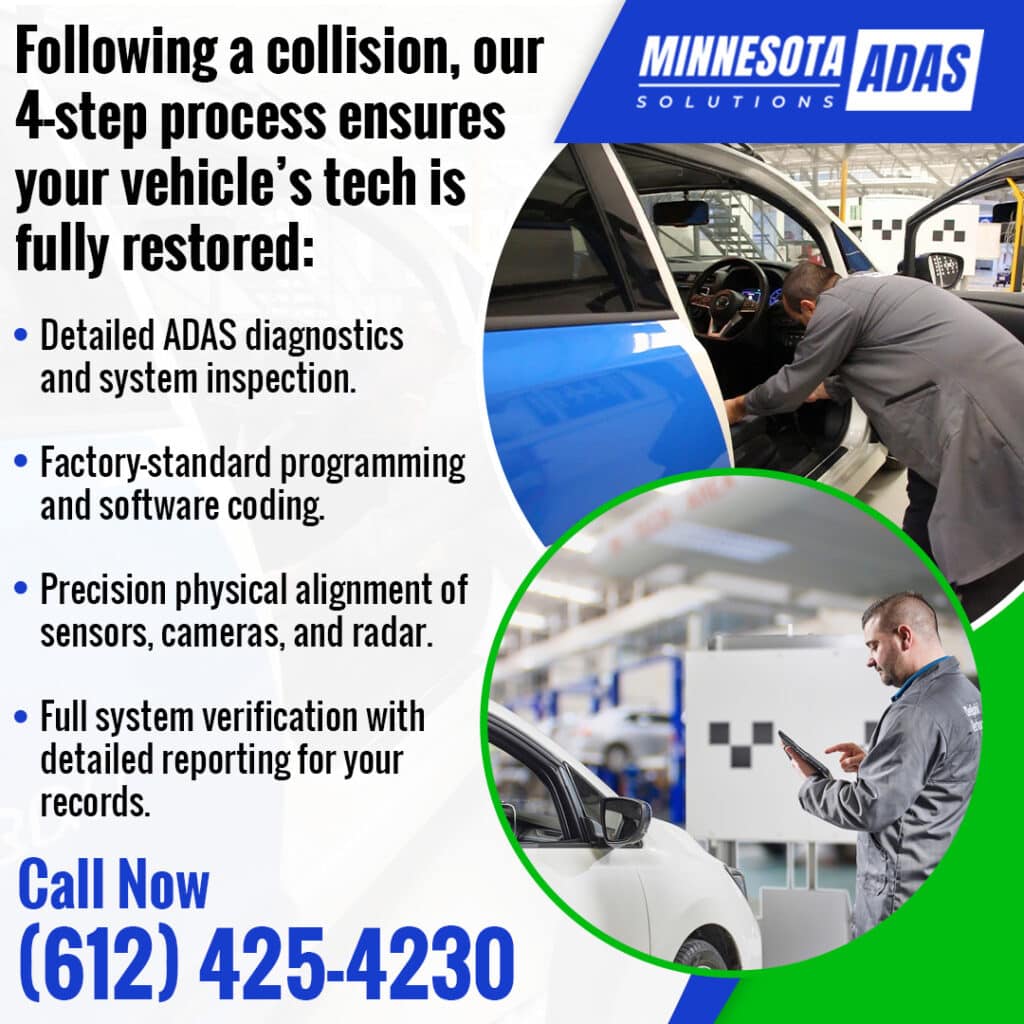
Step 1: Diagnostics and System Inspection
Diagnostics identify misaligned or damaged ADAS components. Technicians examine your vehicle’s cameras, sensors, and radar units to detect any deviations from factory specifications. ADAS diagnostics allow them to pinpoint which components need recalibration or replacement.
This careful inspection reveals hidden issues that might not be visible during a standard repair check, setting the stage for accurate adjustments in the next steps.
Step 2: Programming and Configuration
Programming and coding adjust ADAS systems to factory settings. After identifying the affected components, technicians update the vehicle’s software and configure the system to restore correct communication between sensors, cameras, and the vehicle computer.
Using ADAS programming and coding, each system is aligned to match OEM calibration values. This step prepares the vehicle for precise physical adjustments and restores proper sensor functionality.
Step 3: Precision Calibration
Precision calibration restores system alignment to manufacturer standards. Cameras, radar units, and sensors are fine-tuned to achieve exact angles and detection ranges.
During this stage, technicians confirm lane-keeping assist accuracy, test adaptive cruise control responsiveness, and validate automatic emergency braking performance. By calibrating each component carefully, the vehicle’s safety systems return to reliable operation.
Step 4: Verification and Documentation
Verification confirms all systems operate correctly after calibration. After completing the calibration, technicians perform functional tests to validate system performance in real-world conditions. Detailed ADAS system verification and documentation provide records for repair shops, insurers, and vehicle owners, showing that every step met OEM standards.
All results are recorded to demonstrate compliance with OEM ADAS calibration procedures, giving confidence that your vehicle’s safety systems are fully restored.
Minnesota ADAS Solutions follows this structured process for every vehicle in Bloomington, MN, combining expert diagnostics, programming, precision calibration, and detailed documentation to maintain reliable ADAS performance after any collision.
Importance of OEM ADAS Calibration Procedures
Following OEM ADAS calibration procedures maintains safety and system reliability. Every vehicle model has specific requirements for sensor positioning, software settings, and radar alignment. Skipping steps or using generic methods can lead to incorrect readings, delayed braking, or misaligned lane-keeping assistance.
Deviating from these procedures can compromise forward collision warning or adaptive cruise control, creating unsafe conditions for you and other drivers on the road. OEM procedures provide a roadmap for technicians to bring your vehicle back to the original performance standards after repairs or a collision.
Accurate calibration lowers the chance of false alerts and system failures. At Minnesota ADAS Solutions, we follow OEM ADAS calibration procedures strictly, so every safety feature functions correctly and reliably.
Benefits of Professional ADAS Calibration in Bloomington, MN
Professional ADAS calibration provides measurable improvements in vehicle safety and performance after a collision. It addresses alignment issues, sensor adjustments, and software settings that impact how your vehicle responds on the road.
Accuracy and Safety
Professional calibration returns ADAS systems to factory performance. You can rely on your adaptive cruise control, lane-keeping assist, and automatic emergency braking to operate correctly after repair work. Properly aligned sensors and cameras reduce false alerts, delayed responses, and unintended activations, helping you drive with confidence through busy streets and highways.
Transparency and Documentation
Detailed documentation proves calibration was performed correctly. Every test, adjustment, and verification step is recorded. This provides evidence for repair shops, insurance providers, and vehicle owners that the calibration followed proper procedures and that the vehicle’s safety systems are fully operational.
Timely Service
Most calibrations are completed in 90 minutes. You spend less time waiting for your vehicle, while the technicians adjust each component and verify every system to restore performance after collision repairs.
Minnesota ADAS Solutions combines precise equipment, trained technicians, and a controlled facility in Bloomington to deliver reliable calibration services that get your vehicle back on the road quickly and safely.
FAQs About Post-Collision ADAS Calibration
- What is post-collision ADAS calibration, and why does my vehicle need it?
Post-collision ADAS calibration restores your vehicle’s safety systems after an accident or repair. Collisions can misalign sensors, cameras, and radar units, affecting lane-keeping, adaptive cruise control, and emergency braking. Calibration realigns all components to manufacturer specifications.
- How do ADAS diagnostics in Bloomington, MN, help detect system issues?
ADAS diagnostics in Bloomington, MN, identify misaligned or faulty components quickly. Technicians use specialized tools to test sensors, cameras, and radar units. This step reveals hidden issues that might affect system performance or trigger false alerts.
- What does ADAS programming and coding involve?
ADAS programming and coding update your vehicle software to factory standards. It re-establishes communication between sensors, cameras, and the vehicle computer, preparing systems for precision calibration and restoring correct functionality after a collision.
- Why is ADAS system verification and documentation important?
Verification and documentation confirm all systems operate correctly after calibration. Detailed records show that repair shops, insurers, and vehicle owners who follow each step follow OEM ADAS calibration procedures, maintaining safety and reliability.
Choosing Minnesota ADAS Solutions for Post-Collision ADAS Services
Finding a service provider that focuses only on ADAS calibration makes a difference. You want a team that can handle the technical details without cutting corners.
Certified Facility and Skilled Technicians
Our Bloomington facility specializes exclusively in ADAS calibration. You will work with certified technicians who manage every step of the process, from ADAS diagnostics in Bloomington, MN, to ADAS programming and coding. We check each sensor, camera, and radar unit, then perform precision calibration so your vehicle systems respond properly.
By handling all vehicle makes and models, the team adjusts to your vehicle’s specific needs. You can watch the process unfold and see the systems being tested after every adjustment, giving you confidence in how your safety systems function.
Local Advantage in Bloomington, MN
Minnesota ADAS Solutions provides reliable ADAS services to Bloomington drivers. Because our facility is fully equipped for post-collision ADAS calibration, you receive accurate service in one location without relying on mobile repair. Local access allows you to schedule appointments with minimal delay and have your vehicle serviced by technicians familiar with regional traffic conditions and vehicle trends.
Schedule Your Post-Collision ADAS Calibration Today
Take action now to restore your vehicle’s safety systems with Minnesota ADAS Solutions. Our certified technicians in Bloomington, MN, handle every step of post-collision ADAS calibration, from ADAS diagnostics to programming and coding, precision alignment, and full ADAS system verification and documentation.
Following strict OEM ADAS calibration procedures, we bring every sensor, camera, and radar unit back to proper performance. Contact our team today to schedule your service and confirm your vehicle operates reliably on the road. Call us at (612) 425-4230 or email info@mnadas.com to book an appointment and get your vehicle fully calibrated.