MN ADAS Solutions, Bloomington, provides expert calibration services for Advanced Driver-Assistance Systems (ADAS) to help body shops maintain vehicle safety. You rely on technologies like forward collision warning, calibration, and blind spot monitoring to protect drivers and passengers. Our team also handles adaptive cruise control calibration, lane departure warning calibration, and camera and radar calibration, restoring these systems after repairs or collisions.
By working with a certified facility, you gain access to trained technicians who adjust sensors and cameras with precision. This prevents false alerts, missed warnings, and other errors that can occur when systems are misaligned. Every calibration is documented, giving you clear records for your shop and clients. Whether you manage collision repairs or routine service, we equip you to provide vehicles with properly calibrated ADAS features, keeping drivers alert and vehicles operating safely on the road.
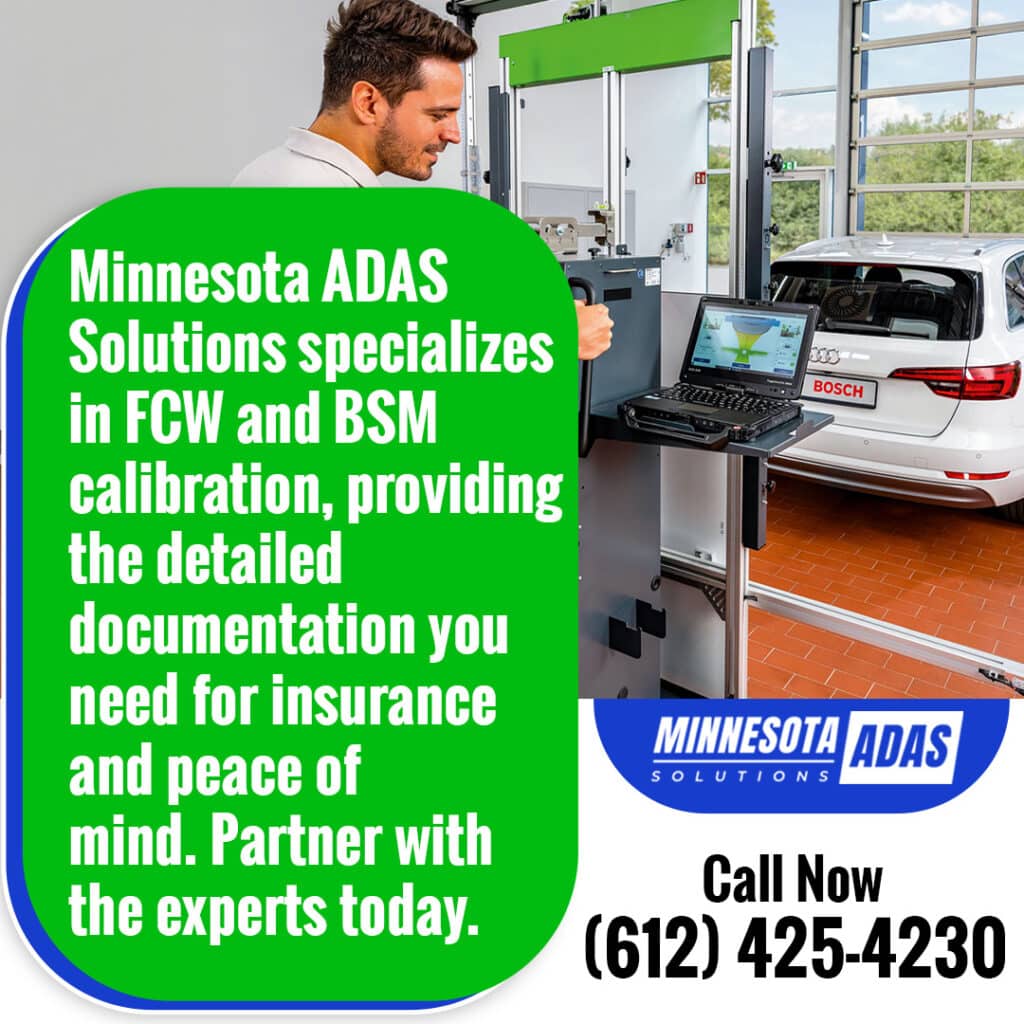
Forward Collision Warning (FCW) Calibration
Forward Collision Warning (FCW) systems are designed to help drivers respond to potential hazards in the lane ahead. Accurate operation of these systems depends on precise sensor and camera alignment after collisions or repairs.
What is Forward Collision Warning?
FCW alerts drivers when a potential frontal collision is detected. Cameras and radar constantly monitor traffic conditions, detecting slower vehicles, stopped traffic, or pedestrians crossing the road. For example, studies from the Insurance Institute for Highway Safety (IIHS) show that vehicles equipped with FCW combined with automatic emergency braking can reduce rear-end collisions by up to 50%.
When the system’s sensors or cameras are misaligned, the alerts may come too early, too late, or not at all. Forward collision warning calibration restores proper function by adjusting each sensor and camera to meet manufacturer specifications, allowing the system to detect hazards accurately.
Why FCW Calibration Matters
Misaligned FCW sensors can cause false alerts or missed warnings. Even a small shift from original positioning can create gaps in detection. Drivers may receive warnings when no obstacle exists, or the system might fail to alert in real situations.
By calibrating FCW sensors correctly, you reduce the risk of false alerts and missed warnings, keeping vehicles functional and drivers confident in the system’s performance.
FCW Calibration Process
- Diagnostics – identifying sensor or camera misalignments: Technicians inspect all FCW components for misalignment. Using diagnostic scanners and alignment tools, they check for deviations in camera angles, radar positions, and sensor readings. This step detects subtle misalignments that may occur after minor collisions or bodywork.
- Sensor and Camera Adjustment – restoring correct positioning: Sensors and cameras are aligned to manufacturer specifications. Proper positioning allows the FCW system to measure distance accurately, track multiple vehicles, and detect pedestrians at the correct range.
- Testing and Verification – confirming system functionality: Calibrated systems undergo verification tests. Vehicles are tested in controlled environments to confirm that warnings trigger at appropriate times. This step replicates real-world driving conditions, such as stop-and-go traffic and highway scenarios.
Examples of FCW Use Cases
- Stop-and-go traffic: FCW helps drivers maintain safe spacing and reduces rear-end collision risk in dense urban traffic.
- Highway driving: The system monitors vehicles at high speeds, providing timely alerts to avoid frontal impacts.
- Pedestrian detection: FCW identifies pedestrians in or near crosswalks, giving drivers additional reaction time to avoid accidents.
Blind Spot Monitoring (BSM) Calibration
Blind Spot Monitoring (BSM) is one of the key systems designed to reduce collisions during lane changes. Proper calibration of these sensors keeps the alerts accurate and reliable after vehicle repairs or collisions.
What is Blind Spot Monitoring?
BSM detects vehicles in areas not visible to the driver. Side-mounted sensors monitor adjacent lanes, helping you know when another vehicle is in your blind spot. Alerts appear through dashboard warnings or side mirror lights, allowing drivers to adjust safely. After a collision or repair, misaligned sensors can reduce system effectiveness, so blind spot monitoring calibration restores their accuracy.
Why BSM Calibration Matters
Misaligned BSM sensors can fail to detect vehicles in blind spots. Even small shifts in sensor angle can cause the system to miss nearby vehicles or trigger false warnings. This may lead to unsafe lane changes, collisions during merges, or accidents in parking areas. Vehicles equipped with properly working BSM reduce lane-change crashes, proving that calibration directly impacts safety outcomes.
BSM Calibration Process
- Sensor Diagnostics – checking sensor alignment and functionality
Technicians evaluate all side sensors. Using advanced diagnostic tools, they confirm that each sensor detects vehicles accurately in adjacent lanes and identifies obstacles correctly. Diagnostics also identify any sensors that may have lost calibration after service or minor collisions.
- Sensor Adjustment – precise realignment in a controlled environment
Sensors are repositioned according to OE specifications. By using a facility built to replicate manufacturer conditions, technicians restore alignment. This process prevents errors caused by shifts during repairs and improves detection reliability.
- System Testing – verifying alerts and detection accuracy
Calibrated BSM systems undergo testing. Each alert is verified for timing and angle, confirming that the system responds correctly when a vehicle enters the blind spot. Controlled testing replicates typical driving scenarios, including highway merges and urban traffic, to confirm sensor performance.
Examples of BSM Use Cases
- Highway lane changes: help prevent collisions while overtaking slower vehicles.
- Merging in city traffic: alerts you to vehicles in adjacent lanes, reducing the chance of side impacts.
- Parking lot maneuvering: detects vehicles alongside your car during tight turns or crowded areas, limiting minor accidents.
Minnesota ADAS Solutions Calibration Advantages
Vehicles rely on advanced safety systems to react to the road faster than a human can. For body shops, handling these systems correctly after a repair or collision means addressing every sensor, camera, and radar with care and precision.
Facility-Based, OE-Standard Calibration
All calibrations are completed at a certified facility. You receive controlled conditions that replicate manufacturer requirements for every adjustment. Services such as adaptive cruise control calibration, lane departure warning calibration, and camera and radar calibration are performed under strict procedures, keeping all components aligned.
Technicians carefully measure and adjust sensors and cameras, making sure the system responds properly to traffic, obstacles, and other road situations. The environment eliminates variables that could interfere with calibration, providing a consistent, reliable process that restores vehicle safety features.
Efficiency and Accuracy
Most calibrations are completed in 90 minutes. You can plan your shop workflow knowing that your vehicles spend minimal time off the lot.
Certified technicians apply step-by-step procedures with precise tools, handling forward collision warning calibration, blind spot monitoring calibration, and other ADAS adjustments without rushing any step. This combination of speed and accuracy keeps your schedule moving while maintaining confidence in the results.
Documentation and Verification
Each calibration comes with detailed reports. You receive records showing all sensor positions, adjustments, and final tests.
This documentation supports body shop records and insurance needs, demonstrating that every ADAS system, whether adaptive cruise control, lane departure warning, or blind spot monitoring, was recalibrated correctly. By keeping thorough records, you can address questions from clients or insurers quickly, showing that vehicle safety systems have been restored professionally.
Why Body Shops Partner with Minnesota ADAS Solutions
You need a calibration partner that delivers accurate results without disrupting your workflow. Minnesota ADAS Solutions, based in Bloomington, MN, works closely with body shops to provide dependable, facility-based services that keep vehicles’ safety systems performing correctly.
Reliable Calibration Services
We focus exclusively on FCW and BSM calibration. Your clients depend on systems like forward collision warning and blind spot monitoring to alert them to potential hazards. Our technicians also manage adaptive cruise control calibration, lane departure warning calibration, and camera and radar calibration, making certain that every sensor and camera operates precisely after repairs or replacements.
By concentrating solely on these systems, we reduce errors that often occur in general repair shops. You can bring vehicles to the facility confident that each component will be adjusted and tested by experts trained specifically in ADAS technologies.
Convenience for Body Shops
Scheduling is simple through live booking at the facility. You can select a time that fits your repair schedule without juggling multiple appointments. Minnesota ADAS Solutions does not provide mobile services; all calibrations take place in a certified center designed for accurate sensor alignment and system testing. This setup allows you to bring vehicles in for calibration and return them quickly, keeping your shop operations on track.
Transparent Pricing and Coverage
Full reimbursement guarantee covers all calibration work. Every calibration comes with detailed documentation, giving you clear evidence of each adjustment performed. This reporting helps with insurance submissions, client communication, and internal record-keeping, allowing you to provide professional service with confidence and clarity.
By partnering with Minnesota ADAS Solutions, body shops access a reliable, facility-based calibration service that combines technical expertise, precise processes, and documented results for forward collision warning, blind spot monitoring, and other ADAS systems.
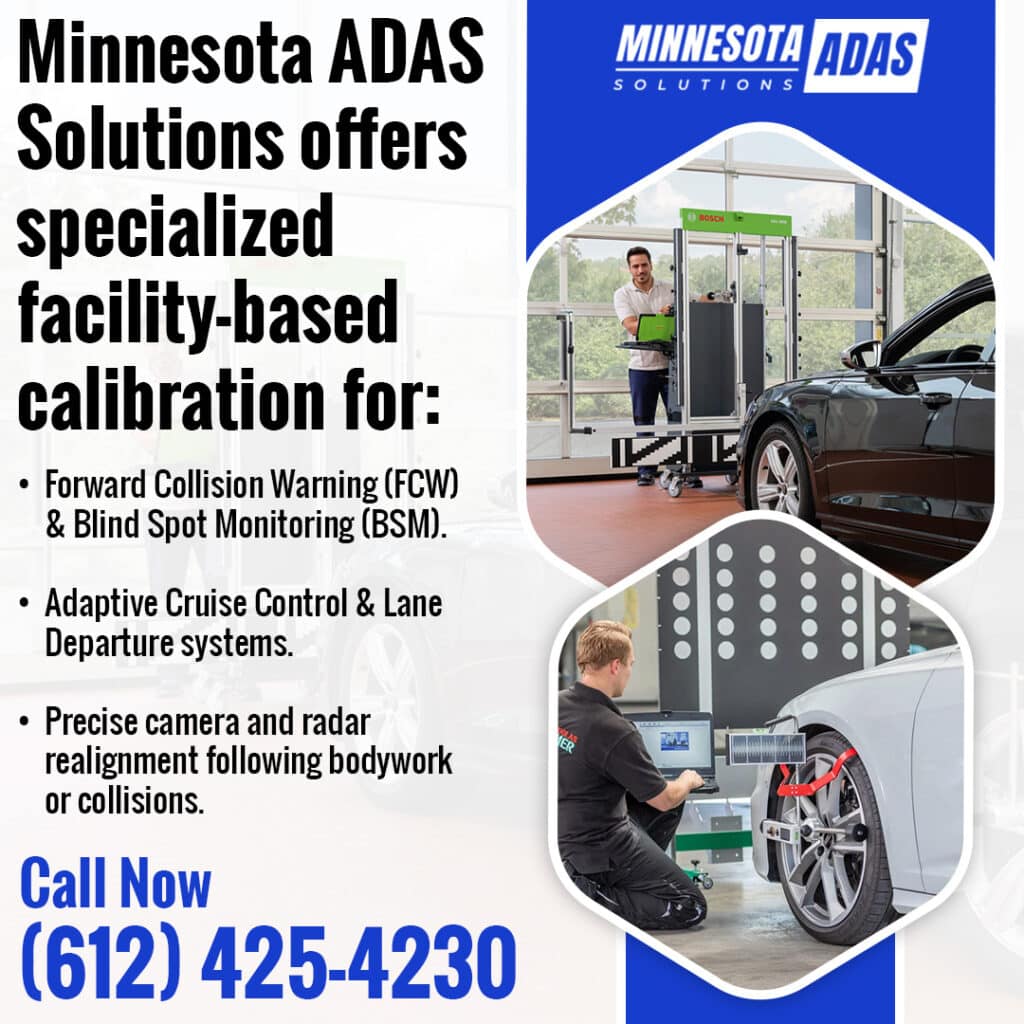
Schedule Your ADAS Calibration Today
Restore forward collision warning calibration, blind spot monitoring calibration, and other ADAS systems with Minnesota ADAS Solutions. Our certified facility provides precise adjustments for adaptive cruise control calibration, lane departure warning calibration, and camera and radar calibration.
Contact our team to book your vehicle for calibration and get detailed documentation for your records. You can reach us at (612) 425-4230 or email info@mnadas.com.